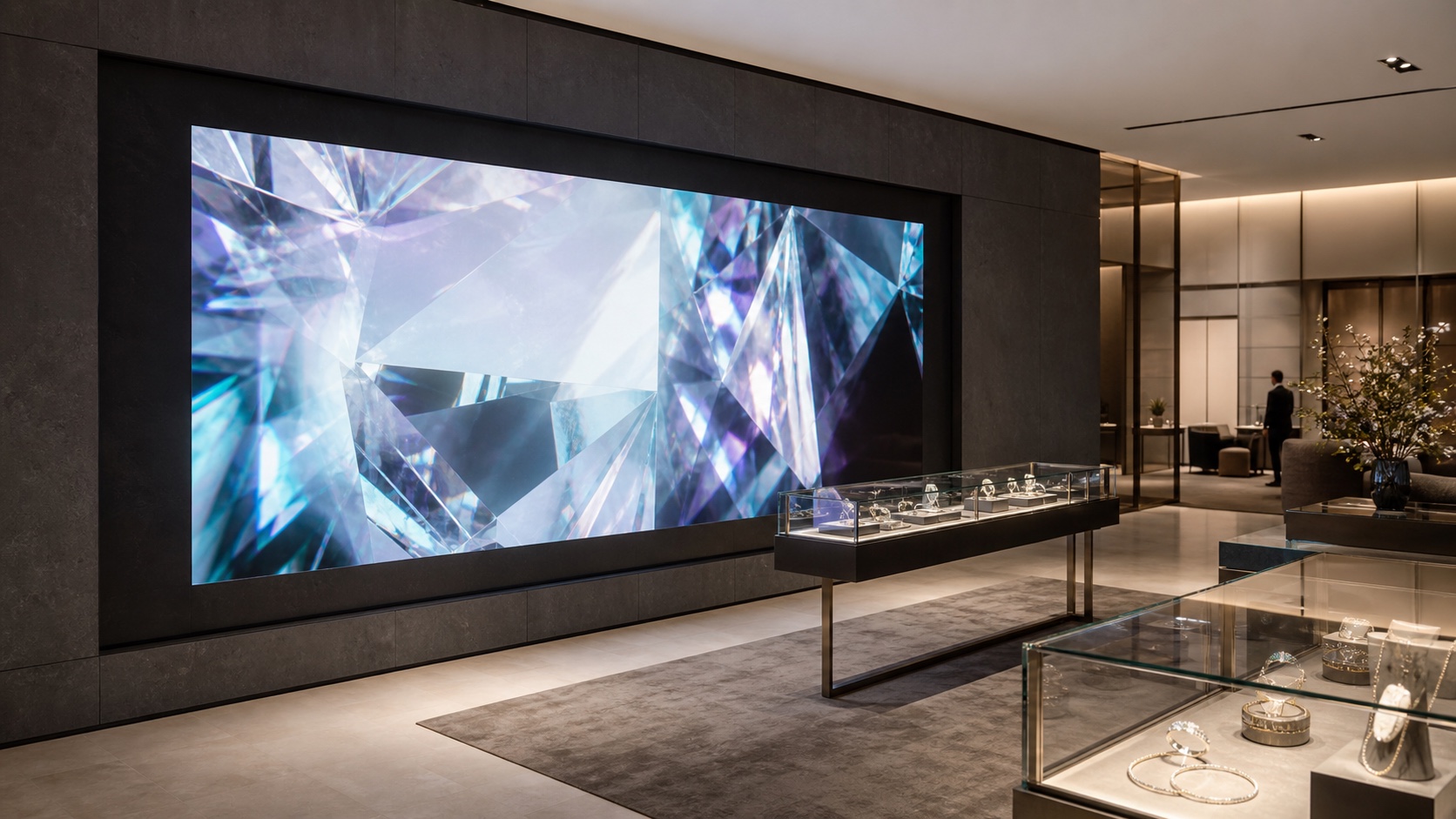
A luxury showroom has to give people a reason to be there in person. The product still matters, but the physical space is increasingly responsible for creating context, emotion, and memory around it. Jewelry salons, fashion ateliers, automotive galleries, and private product rooms are becoming media environments as much as retail environments.
That shift is visible across the industry. ISE has described physical retail as increasingly competing through immersive experience, particularly across luxury, fashion, automotive, and technology spaces. The display is no longer there only to repeat an advertisement. It helps establish the visual language of the room.
MicroLED is well suited to that role because it can be scaled around the architecture, remain seamless at large sizes, hold visual authority under showroom lighting, and move between several content modes without changing the physical surface. Your authorized Opal dealer and AV professional turn that capability into a finished environment by coordinating the wall with light, product placement, content, control, cameras, and service access.
The Specification Problem Is More Than Screen Size
A showroom wall may need to perform four different jobs during the same day. It can carry a campaign image when the salon opens, show detailed product imagery during an appointment, settle into ambient brand motion while guests move through the space, and switch into a focused presentation mode for a private reveal.
Those modes ask different things from the display. Hero content needs scale. Product detail needs precision and disciplined color. Ambient motion needs restraint. Private presentations need control, fast source selection, and a room that can shift without exposing the technical steps behind it.
This is why the AV professional should be involved before the wall elevation, lighting plan, and product zones are finalized. The MicroLED wall is not a layer applied after the showroom is designed. It is one of the surfaces shaping the showroom.
Showroom Content-Zone Elevation
A single MicroLED canvas can support several retail modes when the integrator plans the content architecture and control scenes around how the showroom actually operates.
Jewelry Salons Need Detail Without Visual Noise
Jewelry is experienced at close range. The screen may show stone detail, movement, craftsmanship, provenance, or a campaign image while the physical piece remains the center of the appointment. The wall has to support inspection without competing with it.
Pixel pitch and viewing distance matter here because clients may stand close to the display. Color calibration matters because metal, stone, and finish need to remain believable. Brightness matters because jewelry salons often use carefully layered task and accent lighting that can create reflections and competing highlights.
Your integrator coordinates the display with those conditions and helps the creative team understand what content will hold up in the room. A highly detailed wall cannot rescue imagery that was prepared at the wrong resolution, framed for another aspect ratio, or graded without the showroom lighting in mind.
Fashion Ateliers Need a Flexible Brand Canvas
Fashion spaces move quickly between collection storytelling, appointment support, editorial imagery, live events, and quiet background motion. The wall may need to feel bold during a launch and restrained during a fitting.
MicroLED gives the designer a canvas that can follow the architecture rather than forcing every visual into a fixed object. That flexibility is valuable in ateliers where proportions, materials, mirrors, circulation, and changing product displays already define the space.
The control scenes matter as much as the wall. A launch scene may use full-scale motion and stronger audio. An appointment scene may lower brightness, reduce movement, and bring product detail forward. An ambient scene may leave the room visually active without turning every guest toward the screen.
Automotive Galleries Need Scale and Material Accuracy
An automotive showroom has to support a large physical object. The wall may carry motion footage, configurator imagery, paint and trim detail, engineering visuals, or a private delivery sequence. It needs enough scale to hold the room while remaining secondary to the vehicle when the appointment demands it.
Lighting is especially complex in this environment. Vehicle finishes, glass, polished floors, and architectural lighting all introduce reflections. Wall placement, brightness, camera angles, and content contrast should be studied together so the display looks composed in person and when the delivery is photographed or filmed.
Your AV professional also plans the source path. A brand film, a configurator, a presentation device, and an ambient content system may all need to reach the same wall. The staff interface should make those sources feel like clear showroom modes, not a technical routing exercise.
Private Presentation Rooms Need a Different Kind of Control
Many luxury retail environments include a smaller salon or appointment room where the experience becomes more personal. In that room, the MicroLED wall may support a collection review, custom configuration, product education, provenance material, or a private reveal.
The display should be easy to move from branded ambient content into a focused presentation. Lighting may shift. Audio may narrow to the room. A camera may be used for a remote specialist or private recording. Confidential material may need to disappear immediately when the appointment ends.
These are control and workflow questions, not only display questions. Your dealer and integrator define how the room starts, how staff select content, how external devices connect, how the scene resets, and how the wall returns to a quiet state.
What the Integrator Is Actually Deciding
Across dealer-led retail projects, the wall specification is connected to wall proportion, closest viewing distance, ambient light, pixel pitch, color calibration, content resolution, source routing, control scenes, camera behavior, network reliability, service access, and staff workflow. The showroom feels simple only because those decisions were made before opening day.
Content Must Be Designed for the Room
A large MicroLED wall reveals weak content quickly. Compression, poor scaling, incorrect aspect ratios, low-resolution imagery, and careless loops become part of the architecture once they fill the wall.
The integrator should work with the brand and creative teams early enough to define canvas dimensions, playback requirements, color expectations, content zones, and transition behavior. The content system also needs a practical ownership plan. Someone must know how media is approved, loaded, scheduled, changed, and restored.
That operational layer is easy to overlook during design, but it determines whether the wall stays fresh and useful after the initial launch content has aged.
Service Access Should Disappear Into the Design
Luxury retail architecture depends on clean surfaces and precise detailing. MicroLED supports that approach, but the mounting plane, power and signal paths, ventilation, structure, and service access still need to be resolved.
Your authorized dealer coordinates those requirements with the architect, interior designer, millworker, lighting designer, and contractor. The finished wall should look permanent while remaining practical to support. Serviceability is part of good design, even when the guest never sees it.
The Showroom Becomes a Visual Environment
The strongest retail spaces do not use media as decoration. They use it to connect physical products with story, detail, atmosphere, and presentation. MicroLED makes that possible at architectural scale without dividing the image into separate framed objects.
We design Opal Screens to serve as a permanent visual surface. Your authorized Opal dealer and AV professional shape that surface around the showroom's products, light, content, staff, and appointments.
When those pieces are planned together, the wall does not feel like signage. It feels like part of the place.
Design the Showroom as One Environment
Connect with your authorized Opal dealer to plan MicroLED around your showroom architecture, lighting, content, control scenes, product presentation, and service strategy.
Find Your Integrator